Manicured Rot:
FILIPIÑANA Turns a Golf Course into a Nation 

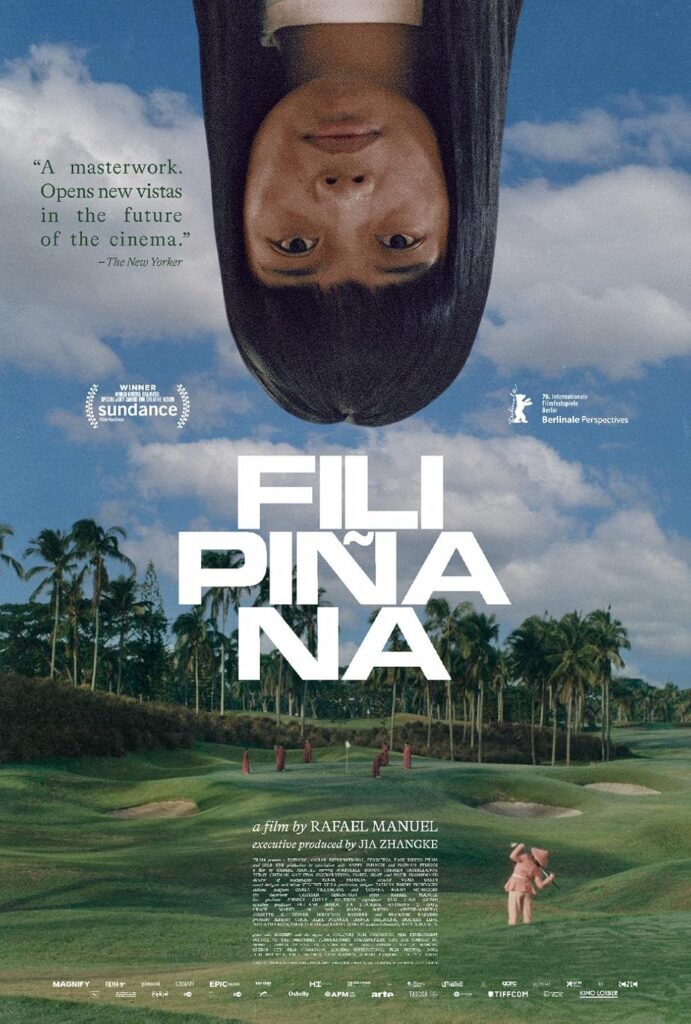
FILIPIÑANA is visually stunning: a Philippine golf course turned into a miniature nation where affluence, labour, folk music and deadpan absurdity expose class as a beautiful, corrupt choreography. The film’s thesis is clear from the start: this manicured world is a miniature of the nation’s social order.

Rafael Manuel’s FILIPIÑANA opens as though Philippine society has been sealed inside the manicured borders of a golf course. The grass is trimmed, the staff are uniformed, the rituals are rehearsed, and yet everything under the surface feels rotten, ritualised and waiting to erupt. It is a film of surfaces — green lawns, white uniforms, polished club manners, sunlit leisure — but its real subject is how those surfaces disguise class power.

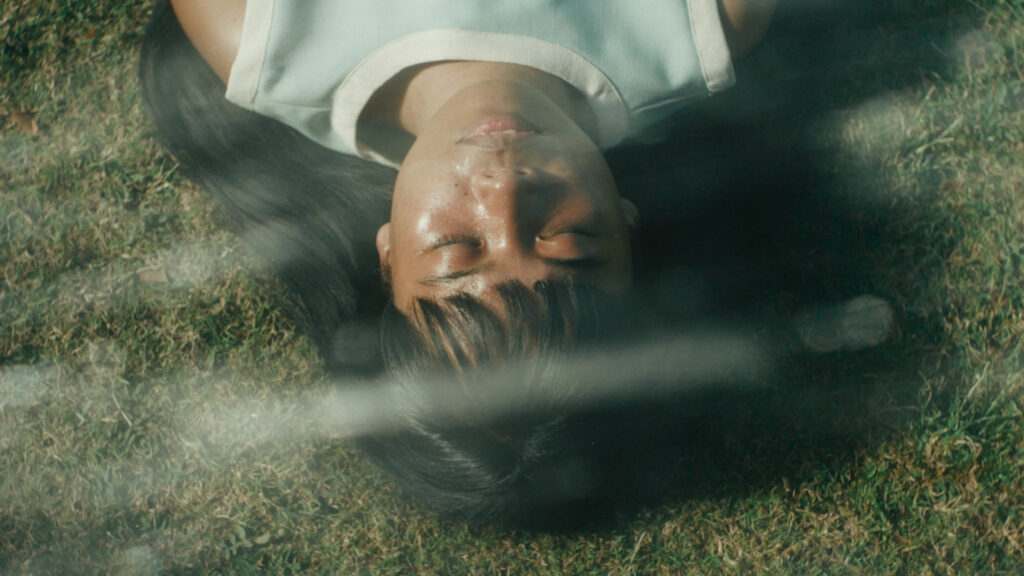
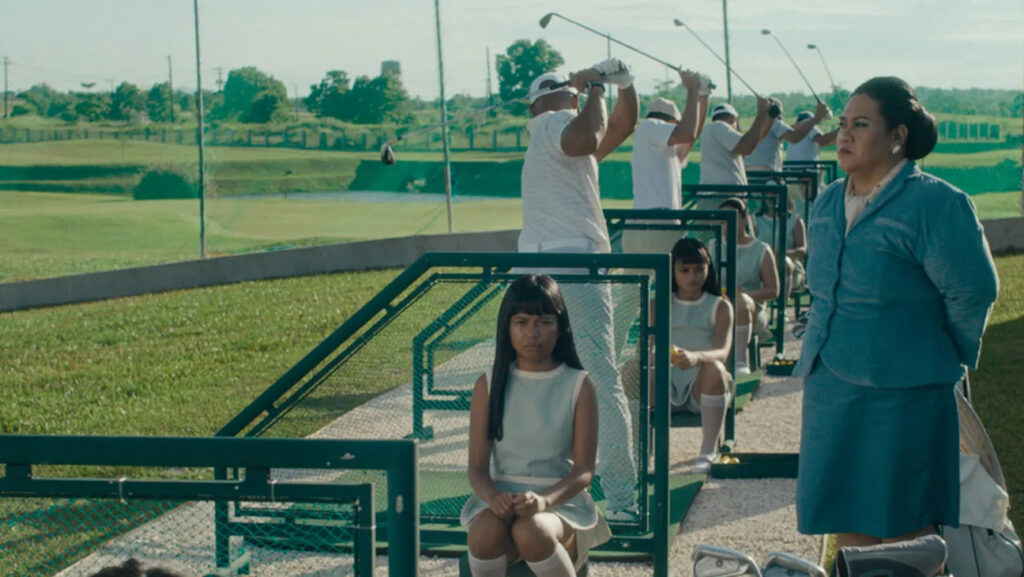
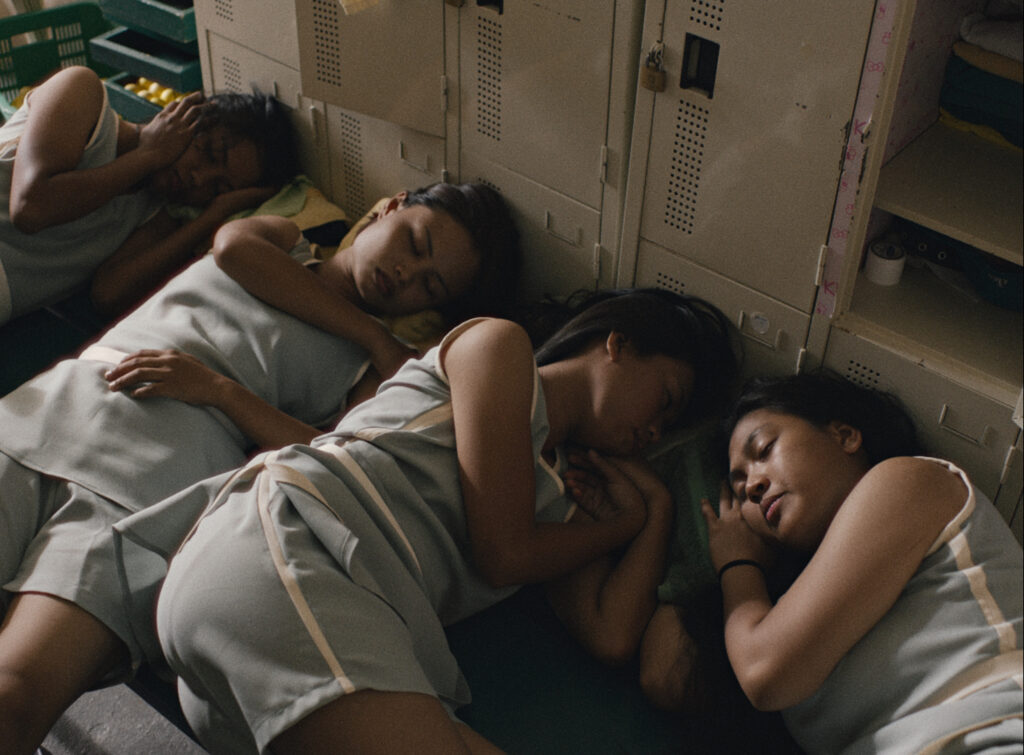
Set in an elite country club outside Manila, the film follows Isabel, a 17-year-old “tee girl” from rural Ilocos, played with remarkable stillness by Jorrybell Agoto. Her work is humble, repetitive and quietly humiliating: she prepares golf balls for wealthy patrons whose leisure depends on an entire underclass of workers they barely acknowledge. Isabel’s world gradually narrows around Dr Palanca, the eccentric club president played by Teroy Guzman, whose presence turns fascination into something stranger, darker and more ominous.

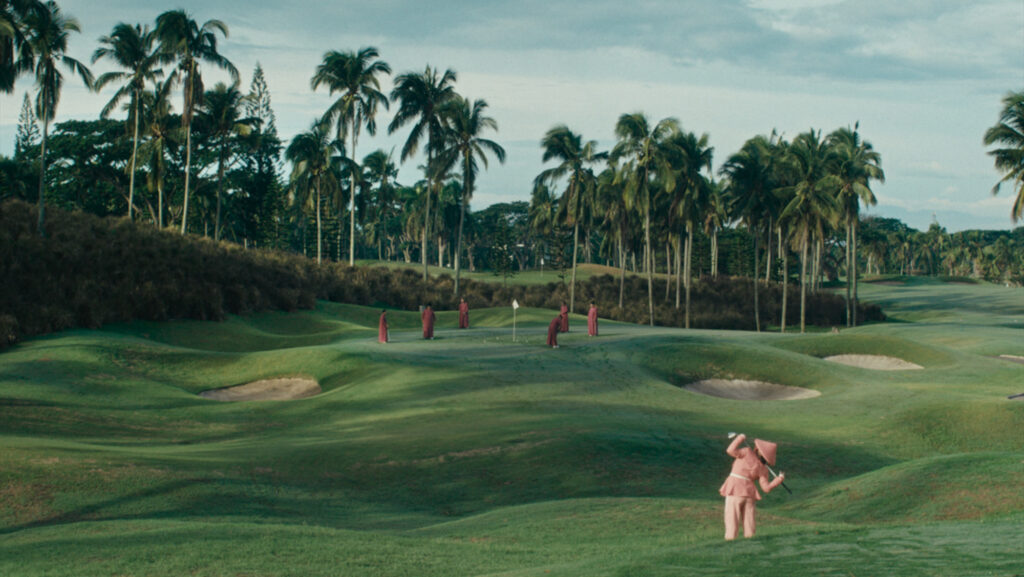
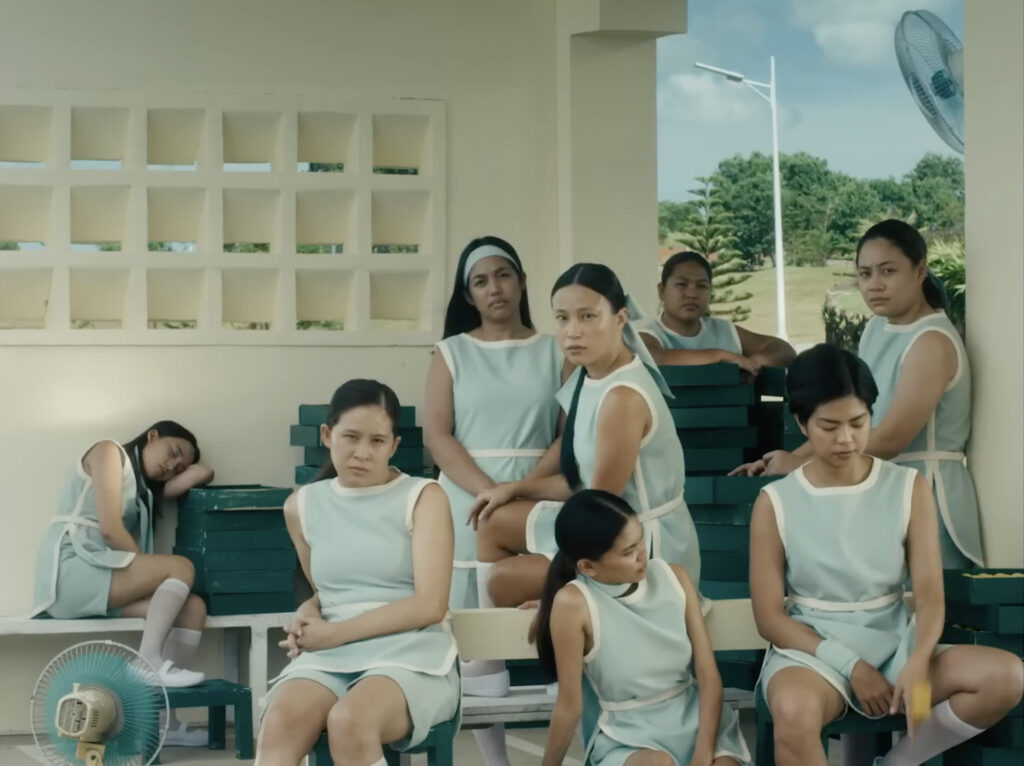
What makes FILIPIÑANA immediately arresting is not the plot but the mise-en-scène. Manuel understands the golf course as a social diagram: a setting of privilege in which every movement has been assigned, every body placed, every worker made part of an aesthetic order they do not control. The film’s best images have the quality of reimagined Filipino landscape art — wide, formal, choreographed, slightly unreal — as if the country’s long history of inequality has been compressed into a single luxurious playground.

The opening is especially intriguing. Manuel exposes us to wide shots of blind performers singing and cleaning staff moving in choreographed patterns to Filipino music. It is funny, beautiful, unsettling and faintly absurd all at once. The workers seem to become part of the club’s ornamental design, their labour converted into spectacle. That tension — between beauty and exploitation — is where the film is most alive.
 
The film’s great strength is its visual imagery and the execution of those images. There are shots that feel almost like macro studies of a national landscape: bodies against grass, uniforms against foliage, sprinklers, carts, golf balls, towels, club interiors and ceremonial gestures arranged with obsessive control. Matched with traditional Filipino music, the images become more than decorative. They form a critique of how Filipino identity is performed, packaged, disciplined and consumed.
 
The familiar folk music is important. “Itik-Itik,” performed by the blind band during the choreographed cleaning of the golf course, gives the sequence a strange double charge: comic and folkloric on the surface, but also disturbing in how culture becomes background entertainment for privilege. “Lulay,” which Isabel hums repeatedly and later sings in a karaoke scene, becomes a motif of circularity — a song of repetition, longing and entrapment, reverberating her own cyclical life inside the resort’s hierarchy. The first moody vocal track used in atmospheric passages deepens the film’s dreamlike unease.
Manuel’s approach to performance is just as striking, and perhaps more divisive. The acting is stoic, slow and deadpan, more reminiscent of Nordic and European art cinema than conventional Filipino drama. One can feel traces of Roy Andersson’s static tableaux and Aki Kaurismäki’s melancholic deadpan: bodies arranged with accuracy, faces flattened into expressionless masks, emotions withheld until the folly of the social world becomes the point.
 
That style is unusual in the context of Filipino cinema, where drama is often more openly emotional, melodramatic or hysterical in pitch. Of course, Filipino masters such as Lino Brocka, Ishmael Bernal and Mike de Leon have long used restraint, repression and controlled performance to devastating effect. But Manuel goes further into an intentionally unnatural deadpan register. His characters often seem less like psychologically rounded individuals than figures trapped inside a social machine.
 
This choice is both the film’s elevation and its risk. For viewers familiar with international arthouse performance traditions, the deadpan style may feel bracingly sophisticated. It abstracts Filipino behaviour into ritual and exposes class relations as choreography. But for viewers expecting the warmer, more instinctive rhythms of Filipino storytelling, the performance style may feel alien, mannered or even emotionally distanced.
 
The contrast is clearest in the early tour-bus sequence, where a transgender tour operator guides Asian tourists with comic energy through Filipino traffic culture. That moment feels recognisably Filipino in its liveliness, social humour and quick comic touch. It carries the kind of natural performance and storytelling cadence that Filipino audiences know well: playful, observant, conversational, alert to the absurdities of everyday life.
 
By comparison, the golf-course world appears deliberately drained of naturalism. Its people do not simply speak; they perform roles inside a rigid social order. The wealthy patrons, tee girls, cleaning staff, managers and club officials all seem trapped in a bizarre national theatre. Manuel’s gamble is that by making the performances artificial, he can reveal the artificiality of class itself.
Not everything works with equal force. Some of the class critique is familiar, even predictable. The oppressed workers, the wealthy patrons, the cruel management, the eccentric rich retired doctor, the over-the-top karaoke, the humiliation of the tee girls — these are recognisable ingredients in Filipino social drama, and at times the film risks leaning on clichés of class oppression that have been seen many times before.
 
Yet even when the content feels familiar, the form keeps rescuing it. FILIPIÑANA is never just another story about the poor being mistreated by the rich. It is a staged attack on inequality in the Philippines, using deadpan performance, folk motifs, painterly compositions and hypnotic sound design to turn a corrupt luxury lifestyle into art. Manuel finds a new visual grammar for an old national wound.
 
What is most compelling is how the golf course becomes a miniature Philippines. It is a colonial landscape masquerading as recreation, a site where imported leisure rituals sit uneasily beside local labour. Golf, with its rules of silence, etiquette, space and exclusion, becomes a perfect metaphor for class power: the rich swing freely while others remain bent, waiting, arranging, retrieving, cleaning, serving.
 
The film’s political intelligence lies in how it makes oppression look beautiful without beautifying oppression. The images are captivating, sometimes ravishing, but the beauty is never innocent. It is the beauty of control. The beauty of exploitation made orderly. The beauty of a society that has learned to choreograph inequality so elegantly that it can be mistaken for culture. That is the film’s central insight: class power can masquerade as refinement.
 
Jorrybell Agoto’s Isabel is key to this uneasy effect. She does not deliver the kind of overt emotional arc that a more conventional film might demand. Instead, she watches, absorbs, hums, waits, repeats. Her face becomes a surface on which the film projects discomfort, curiosity, submission and resistance. The performance is minimal almost to the point of opacity, but that opacity becomes meaningful. Isabel is not fully legible because the sphere around her has not allowed her the luxury of full self-expression.
 
Teroy Guzman’s Dr Palanca, meanwhile, embodies the grotesque eccentricity of privilege. His karaoke performance, his authority, his cultivated weirdness and his position within the club make him less a villain in the conventional sense than a symptom of an entire social order. He is absurd, but the nonsense is dangerous because everyone around him has been trained to accommodate it.

The film’s formal discipline is its most confident achievement. Xenia Patricia’s cinematography gives Manuel’s world a controlled, painterly quality, using distance, composition and stillness to turn the country club into a living installation. The camera often refuses the emotional hints of melodrama. Instead, it observes arrangements of bodies and space until the social violence embedded in those arrangements becomes impossible to ignore.
 
That is why FILIPIÑANA appears less like a conventional drama than a series of social tableaux. Its plot advances, but not always in the expected way. Meaning accumulates through repetition: the golf balls, the songs, the workers’ movements, Isabel’s humming, the routines of service, the rituals of leisure. The film understands oppression not only as dramatic incident but as daily choreography.
 
At its best, the film achieves something rare in Filipino cinema: a critique of class and colonial residue that does not rely solely on dialogue, plot or emotional outburst. It makes the system visible through framing, sound, rhythm and gesture. Its anger is not shouted. It is arranged.
 
Still, the film’s very refinement may also be what limits its emotional reach. The deadpan mode creates distance, and that distance can make certain moments seem intellectually precise rather than viscerally overwhelming. There are times when Manuel’s arthouse control seems to hold the viewer at the edge of feeling rather than fully inside it. It is a deliberate strategy, leaving the film more admired than felt. Whether that is a flaw or the point will depend on the viewer’s taste for this kind of cinema.
For me, the film is fascinating because it exists between two impulses: the international arthouse language of deadpan tableaux and the very Filipino subject of class hierarchy, social performance, folk memory and everyday absurdity. It is both good and bad in that tension. Its weaker elements are familiar; its strongest elements feel singular. It may borrow the grammar of European deadpan cinema, but it applies that grammar to a distinctly Filipino wound.
 
Expanded from Manuel’s acclaimed 2020 short, FILIPIÑANA marks his feature debut as writer, director and editor. The cast is led by Jorrybell Agoto as Isabel, Carmen Castellanos as Clara and Teroy Guzman as Dr Palanca, with a supporting ensemble that includes Carlitos Siguion-Reyna, Isabel Sicat, Nour Hooshmand, Ruby Ruiz, Agot Isidro, Angeli Bayani and Shamaine Buencamino. The film’s cinematography is by Xenia Patricia.
 
Produced by Jeremy Chua, Alex Polunin, Bianca Balbuena, Bradley Liew, Nadia Turincev, Omar El Kadi and Rafael Manuel, FILIPIÑANA is an international co-production involving Singapore, the United Kingdom, the Philippines, France and the Netherlands. It premiered at the World Cinema Dramatic Competition at the 2026 Sundance Film Festival, earning the Special Jury Award for Creative Vision — a fitting recognition for a debut whose power lies less in narrative surprise than in the confidence and originality of its visual language.
 
FILIPIÑANA is not always emotionally natural, nor is it free of familiar class-drama material. But its captive, corrupt world of golf-course luxury, traditional Filipino musical motifs, deadpan performance, and painterly mise-en-scène make it one of the most visually distinctive Filipino debuts of recent years. It turns a country club into a national allegory: a place where the grass is perfect, the songs are familiar, the workers are invisible, and the rot is everywhere
.
Rating: 4/5 Very Good
 
#Filipiñana #PhilippineCinema #AsianCinema #WorldCinema #SFF2026 @sydfilmfest @FilmCritik @BFI @Film4 @MagnifyFilms @filipinofilm @rolmar

Like this article?

Share on Facebook
Share on Twitter
Share on Linkdin
Share on Pinterest

Leave a Reply

Your email address will not be published. Required fields are marked *

More To Explore

Movie Reviews

DOLLY DE LEON’ S ACTING PROWESS IN TRIANGLE OF SADNESS

It is a combined understated yet over-the-top performance from an unassuming role of a cruise yacht “toilet manager” Abigail turned authoritative cougar captain on a desert island. Still, Dolly de Leon meets these acting challenges and delivers an unforgettable cinematic performance in Ruben Östlund’s dark Swedish social satire TRIANGLE OF SADNESS. The 2022 Cannes Palme d’Or winner is a re-examination of class struggle and social manners and is broken into three parts, with the best shock saved for last.

Festival Reviews

The Best Of The French Film Festival 2019

The recent French Film Festival featured a generous 54 films in their lineup. Out of this eclectic collection, I am recommending 23 of them as the best of the lot.